


In the wrong role at work?
There is a moment many capable professionals experience at some point in their career. Work begins to feel heavier than it once did. Tasks that once felt natural require more effort, decisions take longer, and energy fluctuates. In many cases this happens because someone has quietly found themselves in the wrong role at work, even though they are one hundred percent competent to perform it.
The first instinct is usually to personalise this experience.
Perhaps motivation has declined.
Perhaps confidence has slipped.
But sometimes the explanation is simpler.
Sometimes the issue is not the person.
Sometimes the issue is the role itself.
How to recognise when you may be in the wrong role at work
One of the patterns I frequently observe when working with leaders and teams is the quiet erosion of confidence in otherwise capable people.
This rarely begins with obvious performance problems.
Instead, small signals appear first.
Energy becomes inconsistent.
Decision-making slows down.
Tasks that once felt intuitive begin to feel heavier.
From the outside, these changes can easily be interpreted as declining performance.
Yet in many cases the individual is simply in the wrong role at work.
Energy shifts often appear before performance changes
In most organisations, performance is measured through outcomes.
Targets achieved.
Deadlines met.
Projects delivered.
But these measures often reveal problems late.
Energy tends to shift earlier.
When someone is in the wrong role at work, leaders may notice subtle changes such as:
• hesitation when making decisions
• reduced enthusiasm in meetings
• slower engagement with responsibilities
• increased pressure around tasks that once felt manageable
These signals often appear long before formal performance discussions begin.
Research into workplace burnout has shown that emotional exhaustion and disengagement often appear gradually through shifts in energy and motivation rather than sudden performance collapse. The World Health Organization recognises burnout as an occupational phenomenon that develops through prolonged workplace stress that has not been successfully managed.
Understanding these early signals helps leaders look beyond performance metrics and notice patterns earlier.
Why roles sometimes stop fitting
Roles evolve as organisations grow.
Responsibilities expand.
Expectations shift.
Teams restructure.
Over time it becomes possible for capable professionals to find themselves in the wrong role at work, even though their skills and experience remain strong.
The issue is rarely capability.
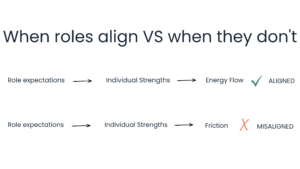
More often it is alignment between:
• responsibilities
• decision authority
• working style
• organisational needs
When these elements drift apart, work begins to feel heavier.
What changes when the role fits again
When someone moves out of the wrong role at work and into a role aligned with their strengths, several things shift quickly.
Energy stabilises.
Confidence returns.
Decision-making becomes clearer.
Often the adjustment required is smaller than organisations expect.
Clarifying responsibilities.
Adjusting decision authority.
Realigning expectations.
Small structural changes can restore both clarity and momentum.
A different question for leaders
When someone appears to be struggling at work, the instinctive question is often:
What is wrong with this person?
A more useful question might be:
Is this still the right role for them?
Sometimes performance improves not because the person changed, but because they were no longer in the wrong role at work.
When these patterns begin to appear
When leaders start noticing these signals within a team, it can be helpful to step back and review how roles and responsibilities are structured.
Conversations about role clarity, decision authority, and leadership expectations can often restore alignment before performance concerns escalate.
If you’re navigating questions about role structure or leadership alignment in your organisation, you can learn more about the advisory work I offer on the Services page of Hands-On Human Resources.
Sometimes the most effective change is not asking people to work harder.
It is ensuring the role actually fits the person.